
Can You Get Dental Implants If You’ve Lost Bone?
Learn how bone loss affects dental implant planning and when grafting, sinus elevation, alternative implant positioning, or another restoration may be considered.
Contemporary Dental Concepts • Tempe, Arizona
The short answer
Bone loss does not automatically rule out dental implants. Depending on bone height, width, quality, location, and nearby anatomy, options may include bone augmentation, sinus-floor elevation, alternative implant dimensions or positioning, or a different restorative plan. Candidacy also depends on gum health, medical factors, smoking, infection control, hygiene, and healing capacity.
Why Does Bone Shrink After a Tooth Is Lost?
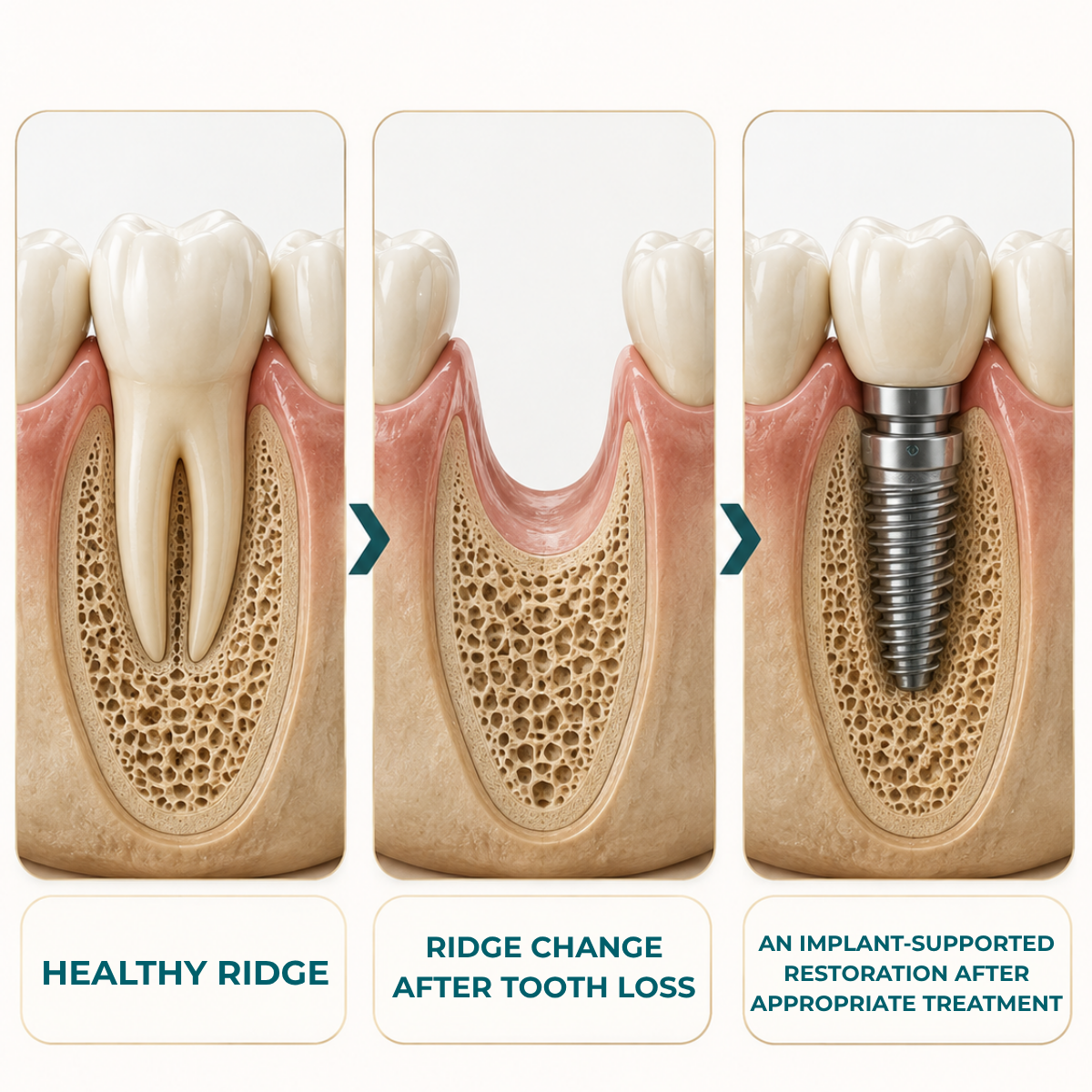
The ridge that supported a tooth can change after extraction because it no longer receives the same functional stimulation. Periodontal disease, infection, trauma, and the anatomy of the original tooth site can also affect the amount and shape of remaining bone.
What matters for implant planning is not simply whether bone loss exists, but where it is, how severe it is, and how it relates to the planned replacement tooth.
- Bone width across the ridge
- Bone height above nerves or below the sinus
- Ridge shape and bone quality
- Gum tissue and periodontal health
- Position required for the final crown
- Space and condition of neighboring teeth
How Is Available Bone Measured?
A clinical examination and conventional dental radiographs provide important information. When appropriate, cone-beam computed tomography, or CBCT, offers a three-dimensional view of bone dimensions and nearby structures such as the maxillary sinus and nerve canals.
Imaging is only one part of planning. The implant must be positioned to support a cleansable, functional restoration, so the desired tooth position helps guide the surgical plan.
When Might a Bone Graft Be Recommended?
Bone augmentation may be considered when the ridge cannot support the intended implant position or when additional contour is needed. Depending on the defect, grafting may be performed before implant placement or at the same appointment. Materials and healing timelines vary.
In the upper back jaw, sinus-floor elevation may create space for bone where the sinus limits available height. Grafting adds treatment and carries its own risks; it is not required in every case and does not guarantee implant success.
- Socket or ridge preservation around extraction
- Localized guided bone regeneration
- Horizontal or vertical ridge augmentation
- Sinus-floor elevation in selected upper-jaw sites
Are There Alternatives to Grafting?
Selected cases may allow shorter or narrower implants, altered implant angulation, or a different number and distribution of implants. These choices have anatomical and restorative limits and are not substitutes for sound diagnosis.
A tooth-supported bridge, removable prosthesis, or a plan that does not use an implant may sometimes be safer or more practical. The best option balances surgery, cleansability, function, appearance, timing, cost, and long-term maintenance.
What Else Affects Implant Candidacy?
Implant assessment extends beyond bone volume. Active gum disease or infection should be addressed, and the clinician considers medical history, medications, healing, smoking or nicotine exposure, oral hygiene, bite forces, and the ability to attend maintenance visits.
Implants cannot develop cavities, but the surrounding tissues can become inflamed or lose support. Daily plaque control and professional monitoring remain essential after treatment.
How Is Treatment Planned?
Restoration first
Identify where the final tooth must sit for function, appearance, and cleaning.
Health assessment
Review periodontal health, infection, medical factors, nicotine use, hygiene, and healing.
Three-dimensional planning
Measure bone and important anatomy with appropriate imaging, which may include CBCT.
Compare pathways
Discuss augmentation, implant alternatives, non-implant options, timing, risks, and maintenance.
I Was Told I Don’t Have Enough Bone for an Implant—What Happens Next?
Frequently Asked Questions
Can you get dental implants with severe bone loss?
Sometimes. Severe bone loss can make treatment more complex, but augmentation, sinus elevation, alternative implant positioning or dimensions, or another restorative design may be possible. A clinical and imaging evaluation is required.
Does everyone with bone loss need a bone graft?
No. The need for grafting depends on the location and shape of the available bone, nearby anatomy, the intended implant and restoration, and the clinician’s assessment. Some patients may have non-grafting or non-implant alternatives.
Can a bone graft and implant be done at the same time?
In selected sites, augmentation and implant placement may be performed together. Other defects need graft healing before an implant can be placed. Stability, anatomy, defect size, infection, and the treatment plan influence timing.
What is a sinus lift?
A sinus lift, or sinus-floor elevation, is a procedure used in selected upper back-jaw sites to create bone below the maxillary sinus for implant placement. Several techniques exist, and it is not necessary for every upper implant.
What can make someone unsuitable for implants?
Uncontrolled dental disease, inadequate healing capacity, certain medical risks, ongoing infection, smoking or nicotine exposure, poor plaque control, or anatomy that cannot support a safe restorative plan may delay treatment or make another option preferable.
Sources and Further Reading
- American Academy of Periodontology: Sinus Augmentation
- PubMed: Bone preservation or augmentation before or with implant placement (2022)
- PubMed: Long-term implants in reconstructed areas with bone grafts (2024)
Sources were selected for clinical context. They do not replace the reviewer’s individualized judgment.
Medical disclaimer: This article is for general educational purposes and does not replace an individualized dental examination, diagnosis, or treatment plan. Treatment options, risks, timing, and outcomes vary by patient.